
General information, not tax advice. Rules and dates change; check the sources at the end of this page.
The rate and the law
Oman’s Value Added Tax Law was issued by Royal Decree 121/2020 and has applied since 16 April 2021, at a standard rate of 5% (as of 26 October 2026). Its Executive Regulations, issued by the Tax Authority’s Decision 53/2021, set out what a tax invoice must contain and when it must be issued. Some supplies are zero-rated or exempt; whether any of yours are is a question for your adviser.
What a tax invoice shows
The Executive Regulations list the details a full tax invoice must carry. In summary, as advisers summarise the regulations (see the sources), a contractor’s tax invoice shows:
- the supplier’s name, address and VAT registration number;
- the customer’s name and address, and the customer’s VAT number where it applies;
- a sequential invoice number, the date of issue, and the date of supply where it is different;
- a description of the work or goods supplied;
- the amount before VAT, the VAT rate, the VAT amount in rials, and the total.
Reports of a 2021 amendment to the Executive Regulations give 15 days from the supply, or from a payment received before it, to issue the tax invoice. Check the current text with your adviser before you set your own deadline.
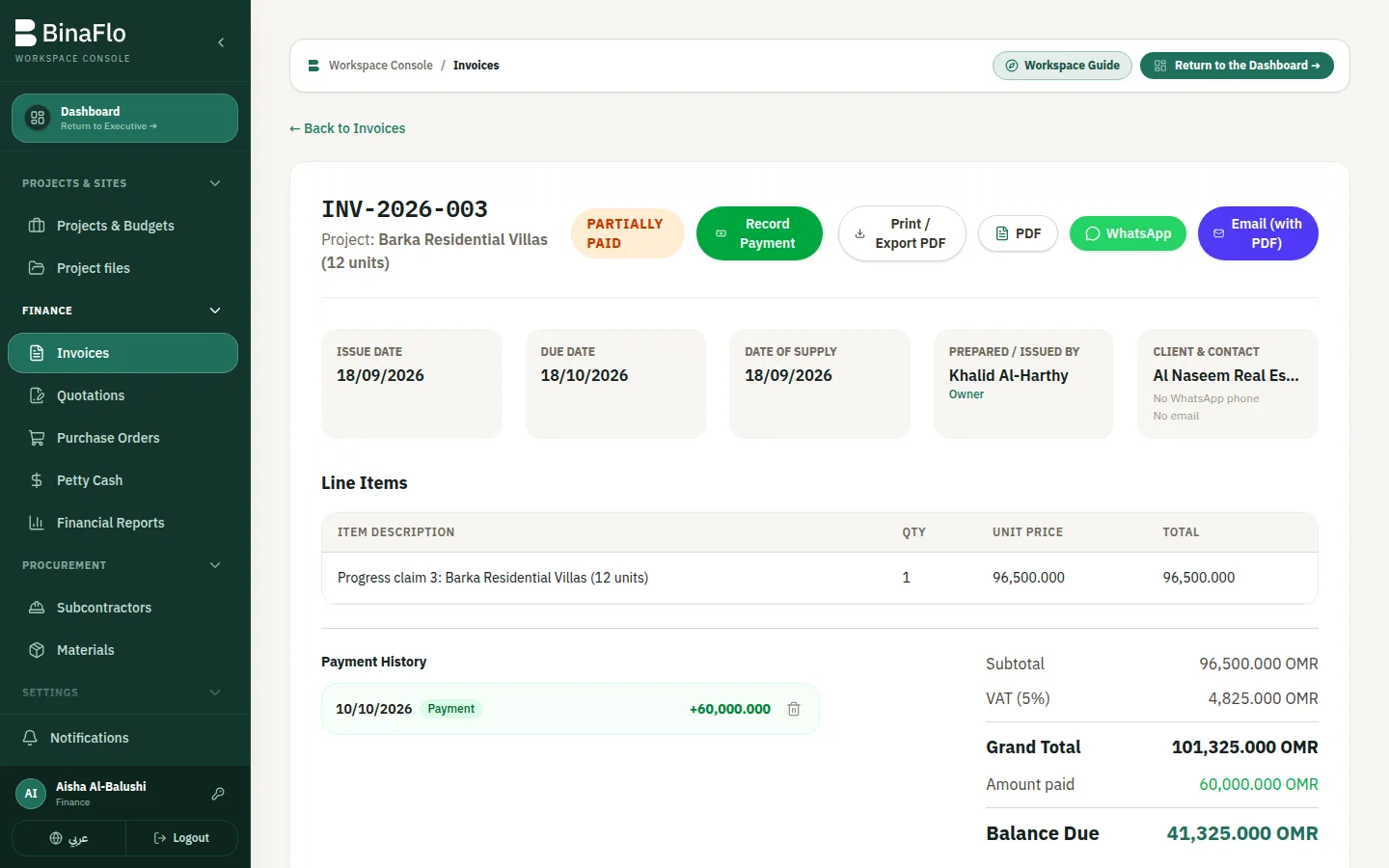
Every screen, invoice and payslip in BinaFlo is available in Arabic and English. A tax invoice in BinaFlo carries your VAT number and calculates 5% VAT, and the VAT summary is ready when you prepare your return.
Invoices, RA bills and stage payments
A contractor often claims money before a tax invoice is due, with an RA bill (payment application). Under the VAT Law, an invoice that shows tax makes the tax due on the date it is issued (Article 30), so a claim that is not meant to be a tax invoice should not show VAT. In BinaFlo an RA bill carries no VAT and prints “This is not a tax invoice”; the tax invoice is issued as its own document. See retention and RA bills for the billing cycle.
Correcting an issued invoice: credit and debit notes
An issued tax invoice is not edited or deleted. If it was too high, or the client is given a reduction, you issue a credit note; if it was too low, a debit note. Each note refers to the original invoice’s number and date and states the reason, and it is kept with your records like the invoice itself.
- In BinaFlo an issued invoice is locked: it cannot be changed.
- Credit notes (CN-2026-…) and debit notes (DN-2026-…) have their own numbering, given when the note is issued, so the sequence has no gaps.
- Each note carries the original invoice’s number and date, a recorded reason and the invoice’s VAT rate, and is locked once issued.
- The invoice’s balance and every report include the notes, so the receivables and the VAT summary stay correct.
Retention on invoices
Retention is part of the price the client has agreed to pay, held back until later. Whether VAT is due on the retained part when the work is invoiced, or when the retention is paid, depends on how and when you invoice and on the payment terms in your contract. Agree the treatment with your tax adviser before your first certificate, and invoice the same way every time.
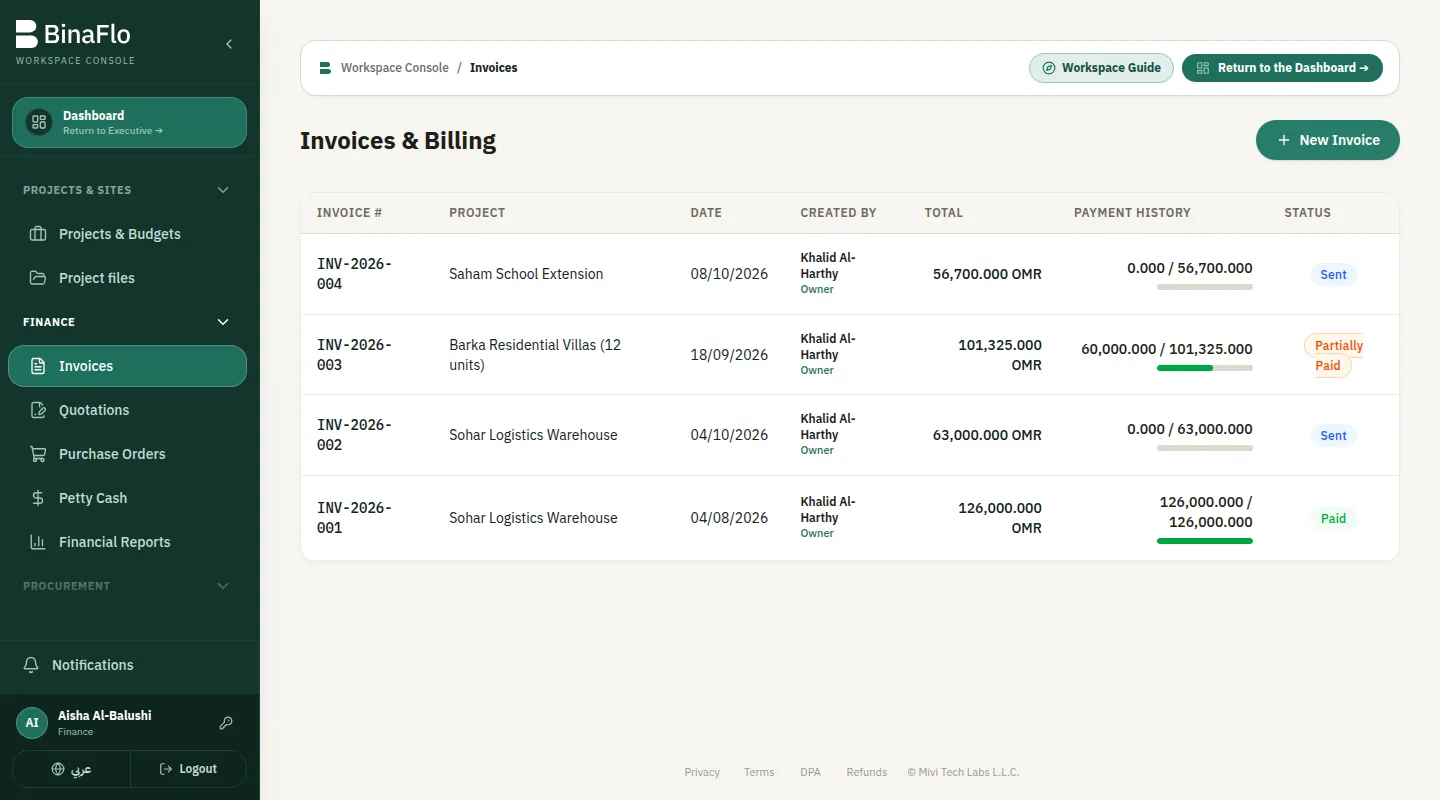
BinaFlo records retention on the invoice and keeps it in receivables until it is released, so the amount the client still owes you is never lost between the invoice and the handover.
E-invoicing (Fawtara)
Oman is introducing e-invoicing, known as Fawtara. Reports from e-invoicing providers describe a phased roll-out that starts with a pilot in 2026, with mandatory dates from April 2027 for the largest taxpayers and October 2027 for the rest. These dates come from secondary sources (listed below); confirm them with the Tax Authority before you plan around them.
BinaFlo has the e-invoicing fields today. E-invoicing is off until a provider is connected, so invoices are not sent to the Tax Authority from BinaFlo yet.
Common mistakes
- Editing or deleting an issued invoice instead of issuing a credit or debit note.
- Showing VAT on a quotation or a payment application that is not meant to be a tax invoice.
- Leaving the client’s VAT number off an invoice to a VAT-registered client.
- Rounding VAT on each line in a way that no longer matches the VAT on the total.
- Treating retention differently from one certificate to the next.
A checklist for every invoice
- Your VAT number and the client’s details are correct.
- The number is the next in your sequence and the date is within the time the regulations allow.
- The description matches the work certified or delivered.
- The amount before VAT, the 5% VAT and the total add up, in rials.
- Retention, advances and earlier payments are shown the way you agreed with your adviser.
- A correction is made with a credit or debit note, never by editing the issued invoice.
Facts and rates checked on 26 October 2026. Laws, rates and dates change: confirm them with the source before you act on them.
Sources
- Oman Tax Authority (taxoman.gov.om): VAT and e-invoicing
- Oman Tax Authority: VAT legislation, Royal Decree 121/2020 and its Executive Regulations (PDF, tms.taxoman.gov.om)
- Deloitte Middle East: Oman issues its VAT Executive Regulations (summary)
- Times of Oman: decision to amend certain provisions of the Oman VAT Executive Regulations
- Fonoa: E-invoicing in Oman, requirements, challenges and solutions
- Banqup: Oman Fawtara e-invoicing status guide
No credit card needed for the trial. Prices: USD 78 (about OMR 30) per month or USD 780 (about OMR 300) per year per company, plus VAT where applicable.
Start your free trial See pricingRelated guides
- BinaFlo: construction ERP for Oman
- What is WPS in Oman, and how a construction company runs WPS payroll
- What a construction ERP is, and what an Oman contractor needs from one
- Construction management software for contractors in Oman
- Retention and RA bills (payment applications) for contractors in Oman
- Features
- FAQ