
The words
- RA bill (running account bill), also called a payment application or interim payment application: the contractor’s claim for the value of the work done up to a date.
- Certificate (interim payment certificate): the amount the client or its engineer accepts for that claim. It can be lower than the amount claimed.
- Retention: a percentage of each certified amount that the client keeps until the end of the work or of the maintenance period, as security for defects. The percentage and the release points are set in your contract.
- Advance payment: money paid at the start of a contract and recovered by deductions from later bills.
Why an RA bill is cumulative
Each RA bill states the total value of the work done to its date, not only this month’s work. The claim for this period is the difference from the previous bill. Working cumulatively protects both sides: if the engineer refuses part of a claim in March and you claim it again in April, a cumulative bill counts it once, and nobody has to add up twelve monthly claims to know where the contract stands.
BinaFlo stores the cumulative value of each RA bill and works out “this period” from the previous one on the same project. Once a bill is certified, the certified figure is the one counted, never the amount that was claimed.
A worked example
Example figures in rials, with 10% retention as an example rate; your contract sets the real rate. VAT is left out here because it belongs on the tax invoice, not on the RA bill (see below).
| Bill | Value of work to date | This period | Retention held back (10%) | Payable this period, before VAT |
|---|---|---|---|---|
| RA-01 | OMR 40,000.000 | OMR 40,000.000 | OMR 4,000.000 | OMR 36,000.000 |
| RA-02 | OMR 95,000.000 | OMR 55,000.000 | OMR 5,500.000 | OMR 49,500.000 |
| RA-03 (certified at OMR 130,000 of OMR 140,000 claimed) | OMR 130,000.000 | OMR 35,000.000 | OMR 3,500.000 | OMR 31,500.000 |
After RA-03, the client holds OMR 13,000.000 of retention (4,000 + 5,500 + 3,500). The OMR 10,000 that was not certified in RA-03 is not lost: it is part of the cumulative value you claim again in RA-04, and only what is certified then is counted.
RA bills, certificates and VAT
An RA bill is a claim, not a tax invoice. Oman’s VAT Law (Royal Decree 121/2020) makes tax due on the date an invoice that shows tax is issued (Article 30), so BinaFlo’s RA bill carries no VAT rate, amount or VAT number and prints “This is not a tax invoice”. The tax invoice, with 5% VAT, is a separate document. When VAT falls due on a stage payment, and on retention when it is released, depends on your contract and on the payment dates: agree it with your tax adviser before your first certificate. Our guide to 5% VAT tax invoices for construction covers the invoice itself.
Retention, step by step
- The contract sets the rate and the release points, for example half at handover and half after the maintenance period.
- Each certificate holds back retention, so the balance held grows with every bill.
- At a release point you record the release: the event, the amount and a note. The balance held goes down by that amount.
- With subcontractors it runs the other way: you hold retention from each subcontractor and release it to them at the points in their subcontract.
How BinaFlo records it
- RA bills per project, numbered RA-01, RA-02 … when they are submitted (your company can change the prefix), with lines or a single cumulative value, and a print view in Arabic and English.
- The contract value is recorded on the project before the first RA bill, so every claim can be read against it.
- The client’s certificate is recorded against each RA bill; the certified amount is the one that counts.
- A draft can be changed or deleted; a submitted RA bill is withdrawn with a reason instead, and a new one made. Every change is in the audit log.
- Retention for each project: withheld, released and still held, with each release event.
- Retention held from each subcontractor, and each release to them.
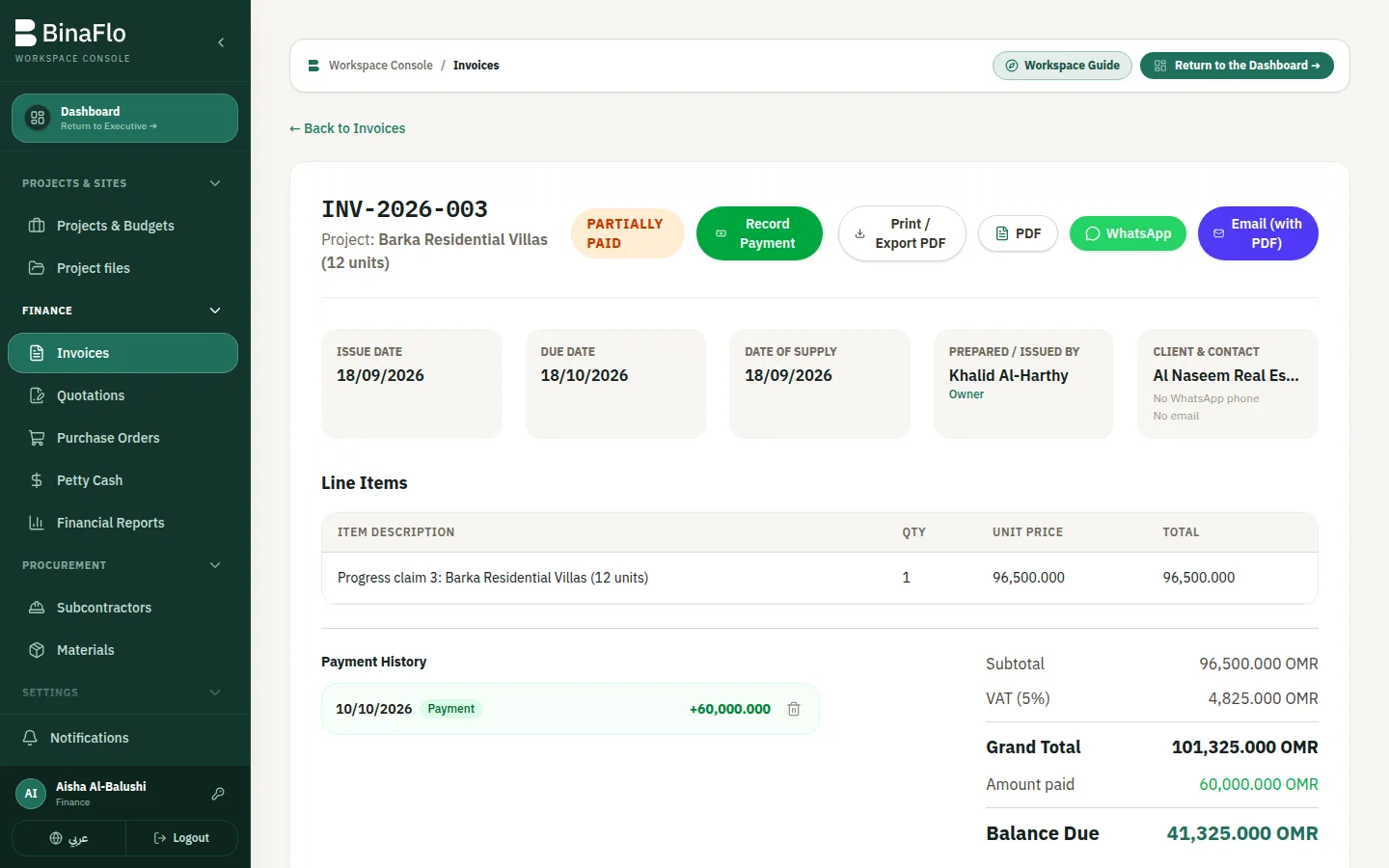
- Advances received on a project, recorded with their receipts.
Advance payments
Some contracts pay an advance at the start, sometimes against a bank guarantee, and recover it by a deduction from each certificate until it is paid back. Record the advance when it is received, so the project always shows how much is still to be recovered. How VAT applies to the advance and to its recovery is a question for your tax adviser.
Keeping the paper trail
Keep each RA bill with its measurement sheets, the engineer’s certificate and the tax invoice that followed it, filed under the project. When the client asks why March was certified lower than claimed, or an auditor asks for an invoice, the answer is in one place. BinaFlo keeps the RA bills, the certificates and the invoices on the project, and its audit log records who changed what and when.
Before you submit a bill
- Check the cumulative value against the contract value and the previous certificate.
- Attach the measurement sheets or the progress photos your engineer asks for.
- Check the retention rate and any advance recovery against the contract.
- Agree with your tax adviser when the tax invoice is issued and how retention is treated for VAT.
- After certification, issue the tax invoice for the certified amount and follow it up in receivables.
Facts and rates checked on 26 October 2026. Laws, rates and dates change: confirm them with the source before you act on them.
Sources
- Oman Tax Authority: VAT legislation, Royal Decree 121/2020 and its Executive Regulations (PDF, tms.taxoman.gov.om)
- Oman Tax Authority (taxoman.gov.om): VAT and e-invoicing
No credit card needed for the trial. Prices: USD 78 (about OMR 30) per month or USD 780 (about OMR 300) per year per company, plus VAT where applicable.
Start your free trial See pricing